
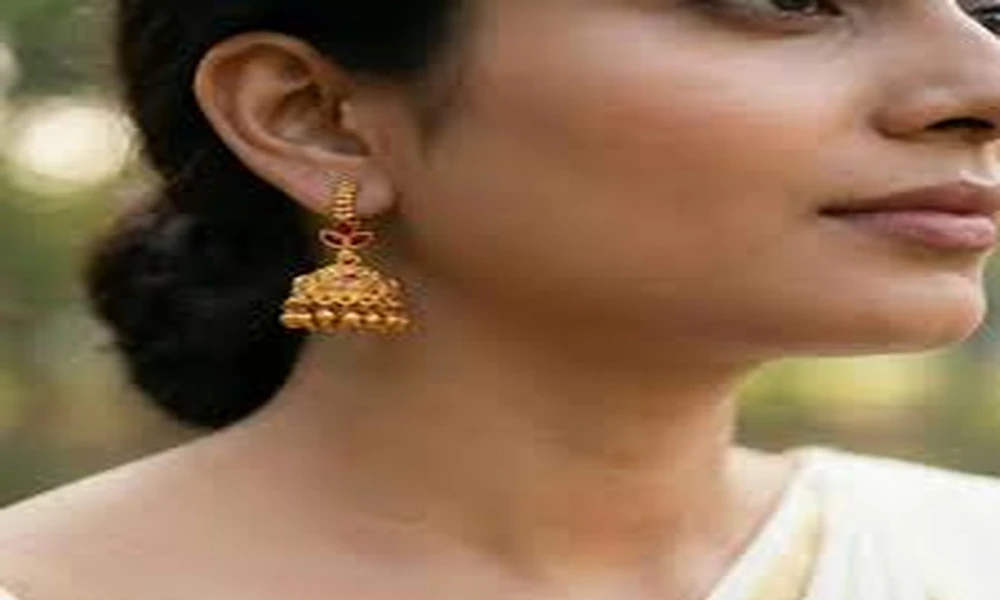
Studs and jhumkas represent different design philosophies and serve different purposes, the choice is less about which is objectively better and more about what your wardrobe actually needs. Both categories have expanded significantly in recent years. Studs women earrings have moved well beyond the plain solitaire into textured, architectural, and statement interpretations. Jhumkas have gone in the opposite direction, with many contemporary versions pared back to suit daily wear.
What Makes Studs the More Consistent Everyday Choice
The defining quality of a stud is that it sits close to the earlobe and moves very little during the day, genuinely comfortable across extended wear and compatible with almost any activity. They do not catch on clothing, do not shift position, and create very little weight on the earlobe.
Studs women earrings on AJIO cover a far wider range than the classic solitaire, geometric shapes, floral motifs, oxidised silver designs, and embellished clusters all sit structurally as studs while delivering very different visual outcomes.
Studs vs Jhumkas at a Glance
Studs and jhumkas both have their place, but they suit very different moments. One is built for ease and versatility, the other for presence and occasion. Comfort, weight, and outfit compatibility all shift the moment you choose one over the other. Here’s how they stack up side by side.
| Factor | Studs | Jhumkas |
|---|---|---|
| Everyday comfort | Very high | Moderate, depends on size and weight |
| Occasion suitability | All occasions | Festive, ethnic, semi-formal best |
| Outfit compatibility | Universal | Strongest with Indian and fusion wear |
| Movement | Minimal | Visible swing and movement |
| Earlobe stress | Very low | Moderate, heavier pieces over time |
| Style range | Minimal to bold | Traditional to contemporary |
What Jhumkas Bring That Studs Cannot
A jhumka does something a stud by design does not: it moves. The swing and catch as you turn your head is part of the experience of wearing one, inseparable from the aesthetic. This is why jhumkas have persisted across centuries with their essential form largely intact, the movement is the point.
Contemporary jhumkas earrings on AJIO range from traditional bell-shaped gold-toned designs to minimalist oxidised silver versions, enamel-worked pieces, and lightweight fabric or thread jhumkas suited to daily wear. These lighter formats have expanded the category well beyond occasion-only wear.
To Wrap Up
Studs and jhumkas earrings solve different problems, and a collection that includes both covers the widest range of contexts. AJIO stocks over 8,000 earring styles across both categories with a free returns policy on eligible orders.
FAQs
1. Which is better for sensitive or stretched earlobes?
Studs, without much qualification. Low weight and minimal movement mean very little stress on the piercing. Heavy jhumkas worn frequently over a long period stretch piercing holes over time.
2. Can jhumkas work in office environments?
Smaller jhumkas, particularly lightweight contemporary designs in minimal metallic finishes, work well in most offices. The distinction is usually size and sound, a small, quiet jhumka reads very differently from a large, elaborate one.
3. Do studs work with traditional Indian outfits?
Yes, particularly statement studs. Larger geometric designs, floral clusters, and stone-set pieces in traditional motifs hold their own with ethnic wear best when the stud has enough visual weight to balance the fabric.
4. What is the difference between a jhumka and a chandbali?
Both are traditional Indian earring forms but structurally distinct. A jhumka hangs from a dome or bell-shaped base. A chandbali is crescent-moon-shaped, with a different swing dynamic and a distinctly different line at the jaw.
5. How do I prevent jhumka hooks from causing irritation?
Silver or gold hooks are the most skin-friendly. Surgical steel and titanium are good alternatives for sensitive skin. Nickel-based hooks are the most common cause of earring-related irritation, worth checking specifically on lower-priced pieces.

Comments are closed.